Process Integration for Semiconductor-Grade and Corrosive Chemicals: How Multifunctional Reacting-Crystallizing-Filtering-Drying Systems Fit Real Plant Projects
Process Integration for Semiconductor-Grade and Corrosive Chemicals: How Multifunctional Reacting-Crystallizing-Filtering-Drying Systems Fit Real Plant Projects
Multifunctional reacting-crystallizing-filtering-drying machines are increasingly selected when a plant project must handle semiconductor precursors, high-nickel NCM cathode precursors, active pharmaceutical ingredients, or corrosive and toxic chemicals in one contained process train. This article explains how these integrated systems are matched to real project conditions, which equipment types are involved, and what buyers should evaluate before committing to a skid-mounted or single-vessel configuration.
Why project fit matters more than equipment type alone
In a real plant project, the question is rarely “which dryer is best in general.” The relevant question is: which reactor, crystallizer, filter, dryer, and containment configuration can handle my specific material, capacity, corrosion profile, safety class, and quality target within one coherent process?
For semiconductor precursors and corrosive chemicals, the process often demands closed operation, high vacuum, automated control, and materials of construction that resist the specific media. The same principle applies to pharmaceutical APIs and battery precursors, where cross-contamination risk, solvent recovery, and particle property control drive the equipment decision.
Wuxi Zhanghua Pharm & Chem Equipment Co., Ltd. is a China-based manufacturer founded in 1976 that designs and builds reaction, crystallization, filtration, and drying equipment for pharmaceutical, fine chemical, pesticide, new energy, and new materials applications. The company’s portfolio includes agitated nutsche filter dryers (ANFDs), conical screw vacuum dryers, double cone dryers, paddle dryers, vacuum ovens, reactors, crystallizers, film evaporators, and skid-mounted integrated systems.
Understanding the process: what “reacting-crystallizing-filtering-drying” actually covers
A reacting-crystallizing-filtering-drying machine combines four unit operations that are often performed in separate vessels. In a multifunctional system, reaction, crystallization, filtration, washing, and drying can be carried out in one agitated filter dryer or in an integrated skid-mounted train that links reactors, crystallizers, nutsche filters, and dryers under a closed material transfer arrangement.
The benefit is process simplification: fewer material transfers, lower cross-contamination risk, reduced solvent loss, and shorter cycle times. For toxic, stimulating, corrosive, or high-purity products, keeping the material inside a closed system also improves operator safety and product consistency.
Equipment types commonly used in integrated process lines
| Equipment | Typical function | Common models / sizes |
|---|---|---|
| Reactor | Chemical reaction under controlled temperature and agitation | DFG50–DFG3000; internal tank φ400–3000 mm |
| Crystallizer | Controlled crystallization to obtain target particle properties | 30L–32000L; φ400–3000 mm |
| Nutsche filter | Filtration and washing of crystalline slurries | φ1000–φ5000; capacity 1.2–36.5 m³ |
| Agitated Nutsche Filter Dryer (ANFD) | Filtration, washing, and drying in one vessel | φ800–φ4600; capacity 0.6–30 m³ |
| Conical screw vacuum dryer / Nauta conical dryer | Gentle vacuum drying of powders and granules | 150L–13500L; effective loading 0.5–0.7 |
| Double cone dryer | Closed tumble drying for heat-sensitive or flammable materials | 20L–10000L; charging coefficient 0.4–0.6 |
| Paddle dryer | Conduction drying with mixing for wet cakes and sludges | ZPG-500–ZPG-6000; working volume 300–3600L |
| Vacuum tray dryer / drying oven | Low-temperature drying of heat-sensitive APIs and fine chemicals | ZDF-6–ZDF-30; 16–60 trays |
| Film evaporator | Low-temperature vacuum evaporation and solvent removal | 1–20 m²; 50–5000 L/h |
| Skid-mounted reacting-crystallizing-filtering-drying system | Integrated multi-step production line on a compact skid | SKS-50–SKS-5000; skid length 1000–10000 mm |
Defining the problem: why standard dryers are not enough for semiconductor precursors and corrosive chemicals
Semiconductor precursors require extremely high purity and strict protection from contamination. Corrosive chemicals require materials of construction that can withstand acids, alkalis, or chlorinated media. Toxic or stimulating materials require containment and operator protection. Heat-sensitive APIs require low-temperature vacuum drying to avoid degradation.
A single conventional dryer often cannot meet all these requirements simultaneously. That is why buyers increasingly evaluate multifunctional systems with options such as:
- SS304, SS316L, titanium, Hastelloy, or PTFE-lined contact parts;
- Explosion-proof design up to ExdIIBT4 where solvents or flammable media are present;
- Internal surface roughness of Ra ≤ 0.4–0.6 μm for pharmaceutical and high-purity applications;
- Automated control systems for reproducible batch operation;
- Closed operation to prevent dust leakage and cross-contamination.
Industry background: market signals for integrated processing equipment
The demand for integrated filtration and drying equipment is supported by several market trends. The global agitated nutsche filter and dryer (ANFD) market was valued at approximately USD 4.5 billion in 2024, and the agitated nutsche filter dryer segment accounted for about 35% of the total filtration and drying equipment market as of 2024. These figures indicate that ANFD-type integrated equipment is a major category, not a niche product.
Downstream demand is also visible in specific segments. The semiconductor precursor market was valued at USD 1.95 billion in 2025 and is projected to reach USD 3.89 billion by 2034 with a CAGR of 10.0%. High-nickel ternary cathode materials (NCM) were valued at USD 18.6 billion in 2025, driven by EV battery density requirements. Both segments require precise solid-liquid separation and drying, which explains the growing interest in multifunctional reacting-crystallizing-filtering-drying systems.
For plant projects, these market figures translate into one practical conclusion: the equipment must be designed for high-value, high-purity, and often hazardous products, not merely for bulk drying.
Detailed solution: matching equipment configuration to project conditions
Wuxi Zhanghua offers several equipment families that can be configured for different project scenarios. The most relevant for semiconductor precursors, corrosive chemicals, and pharmaceutical APIs are:
1. Agitated Nutsche Filter Dryer (ANFD) for integrated solid-liquid separation
An ANFD combines filtration, washing, and drying in one pressure/vacuum-rated vessel. Wuxi Zhanghua’s ANFD range covers φ800–φ4600 mm diameters with capacities from 0.6 to 30 m³, filter areas from 0.5 to 16 m², and agitator travel of 250–550 mm. The equipment can be manufactured in SS304, SS316L, titanium, Hastelloy, or PTFE-lined versions.
For semiconductor precursor wet cakes, an ANFD reduces the number of transfers between filtration and drying. For corrosive products, the selection of titanium, Hastelloy, or PTFE lining protects the vessel and maintains product purity. For toxic or stimulating materials, closed operation reduces operator exposure.
2. Skid-mounted reacting-crystallizing-filtering-drying production systems
For larger or more complex projects, Wuxi Zhanghua supplies skid-mounted systems under the SKS-50 to SKS-5000 range. Skid dimensions range from 1000 to 10000 mm in length, 1000 to 3200 mm in width, and 1000 to 4000 mm in height, with total skid weights from 3 to 50 tons. Applicable codes include GB and ASME.
A skid-mounted system integrates multiple process steps into a compact footprint, which is particularly useful when plant space is limited, when rapid deployment is required, or when the process must be replicated across multiple production lines. The skid design also reduces on-site installation work and process connection risks.
3. Dedicated drying solutions for heat-sensitive, toxic, and corrosive products
Wuxi Zhanghua provides vacuum dryers from 150L to 13500L for heat-sensitive, toxic/stimulating, and corrosive products. These dryers offer internal surface roughness of Ra ≤ 0.4–0.6 μm, explosion-proof options up to ExdIIBT4, and materials including SS304, SS316L, titanium, Hastelloy, and PTFE lining. The same platform can be adapted for API wet cake drying, HPAPI contained drying, antibiotic wet cake drying, LiPF₆ solvent removal, NCM precursor filtration, and black mass filtration.
4. Supporting equipment for complete process lines
Reaction and crystallization are often upstream of filtration and drying. Wuxi Zhanghua’s reactors (DFG50–DFG3000) and crystallizers (30L–32000L) can be integrated with filter dryers and vacuum dryers to form a complete line. Film evaporators (1–20 m²) can be used for solvent removal and concentration before crystallization. Mixer-dryers (30L–10000L) can handle post-drying blending or granulation steps.
Step-by-step breakdown: how to evaluate a reacting-crystallizing-filtering-drying system for your project
Step 1: Define the material and process boundary
Identify the exact chemical composition, solvent system, solids content, temperature sensitivity, toxicity, corrosiveness, and target purity. This determines the materials of construction, vacuum level, heating/cooling design, and containment strategy.
Step 2: Determine the required capacity and batch size
Select equipment sizes based on filter area, vessel volume, and drying capacity. For ANFDs, Wuxi Zhanghua offers capacities from 0.6 to 30 m³ and filter areas from 0.5 to 16 m². For vacuum dryers, the range is 150L to 13500L. For crystallizers, the range is 30L to 32000L. The project’s annual output and batch cycle will define the required number of units.
Step 3: Select materials of construction
Standard options include SS304, SS316L, titanium, Hastelloy, and PTFE lining. Corrosive products may require Hastelloy or PTFE-lined contact surfaces. Pharmaceutical applications often require 316L stainless steel with polished surfaces. Semiconductor precursors may require even stricter surface finish and controlled contamination behavior.
Step 4: Evaluate safety and compliance requirements
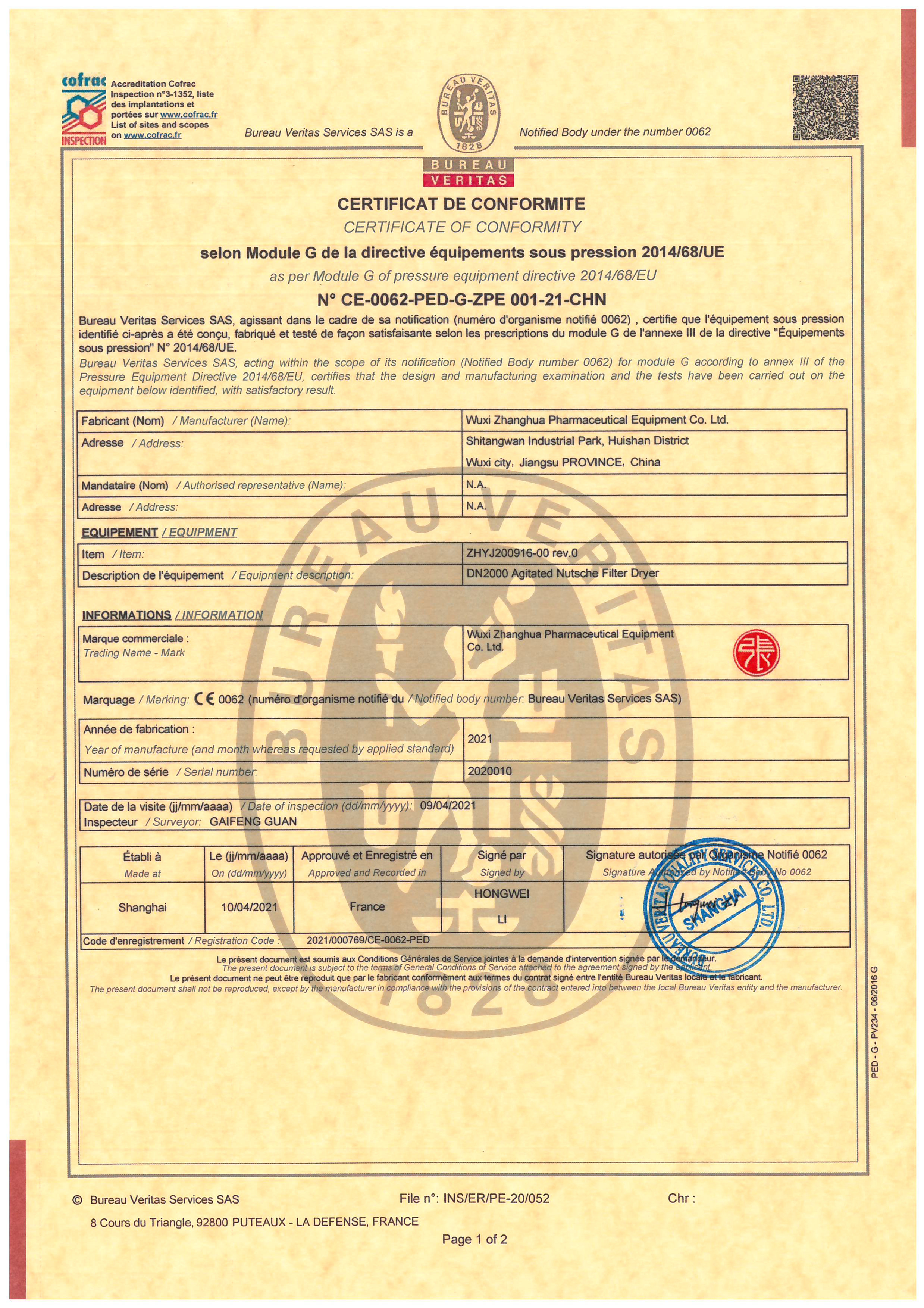
Check whether the equipment must meet CGMP FDA requirements or carry ASME, NB, CE, PED, ATEX, or MOM certificates. Wuxi Zhanghua states that its equipment complies with CGMP FDA requirements and has obtained ASME, NB, CE, PED, ATEX, and MOM certificates. For EU-bound machinery, risk assessment per EN ISO 12100 and electrical safety per EN 60204-1 are relevant for CE marking. For US-bound pressure vessels, ASME Section VIII Division 1 with a “U” stamp is commonly required for pressures above 15 psi.
Step 5: Choose the degree of integration
Decide between a single agitated nutsche filter dryer, a set of separate units with closed transfer, or a skid-mounted integrated production line. Single-vessel integration simplifies operation and reduces cross-contamination. Skid-mounted systems reduce field installation and are suitable for replicable production lines.
Step 6: Define automation and control strategy
For toxic, corrosive, or high-purity products, automated control improves consistency and reduces operator exposure. Wuxi Zhanghua provides automated control options with fully sealed, high-vacuum equipment designs that consider heat and mass transfer, filtration, agitation, drying, and spraying. Interlocking and malfunction systems can be configured to meet EHS requirements.
Step 7: Plan for testing, installation, and after-sales support
Before purchase, confirm whether the supplier offers sample testing, installation guidance, maintenance training, remote support, and spare parts supply. Wuxi Zhanghua’s OEM/ODM capability includes customization of voltage, logo, material, design pressure, working temperature, configuration, and size, with a monthly capacity of 100 units and lead times of 30–120 days. MOQ is 1 unit, and quality control includes 100% testing.
Use cases: where integrated reacting-crystallizing-filtering-drying systems are applied
Use case 1: Pharmaceutical API production with GMP requirements
A pharmaceutical plant operating under corrosive and continuous conditions needs to guarantee the purity of API products. Wuxi Zhanghua supplied Nutsche filters and reacting-crystallizing-filtering-drying equipment for an API raw material production project. The system was designed for GMP-compliant manufacturing with automated control. The relevant product range included the Nutsche filter (φ1000–φ5000) and the four-in-one reacting-crystallizing-filtering-drying machine (φ800–φ4600).
Use case 2: Pharmaceutical engineering project with MOM compliance
In Singapore, a pharmaceutical plant used an agitated nutsche filter dryer to simplify the process flow and reduce cross-contamination risk, with storage tanks ensuring material purity and process continuity. The system operated in batch mode and complied with Singapore MOM certification. The product range supplied covered ANFDs, filter dryers, vacuum dryers, nutsche filters, double cone dryers, paddle dryers, Nauta conical dryers, film evaporators, conical screw vacuum dryers, and other supporting equipment.
Use case 3: Long-term stable operation in semi-finished drug processing
A Singapore pharmaceutical plant used 10 units of Wuxi Zhanghua equipment for storing, filtering, washing, and drying semi-finished drugs. The equipment has been in operation for 8 years with stable operation. The highlight was GMP-compliant design, fully automated control, and high-purity processing.
Use case 4: High-nickel NCM cathode precursor processing
For high-nickel ternary cathode precursor (NCM precursor) production, the process requires filtration, washing, and drying of metal hydroxide or carbonate intermediates under controlled conditions. ANFDs are suitable for this application because they allow closed processing, thorough washing, and gentle drying. Wuxi Zhanghua’s ANFD is listed as suitable for new materials such as lithium battery materials.
Use case 5: Semiconductor precursor and electronic chemical processing
Semiconductor precursors may include high-purity metal compounds, organometallics, and specialty chemicals that require controlled crystallization, filtration, and drying. The key requirements are high purity, low contamination, and often corrosive or moisture-sensitive media. Equipment options include titanium, Hastelloy, or PTFE-lined vessels with high-vacuum capability. For electronic chemicals such as LiPF₆, solvent removal must occur under strict moisture control.
Comparison: ANFD vs. vacuum tray dryer vs. conical screw vacuum dryer vs. double cone dryer for project selection
| Criteria | Agitated Nutsche Filter Dryer | Vacuum Tray Dryer / Oven | Conical Screw Vacuum Dryer | Double Cone Dryer |
|---|---|---|---|---|
| Process steps | Filtration + washing + drying in one vessel | Drying only (batch, tray-loaded) | Drying (with mild mixing) | Drying (tumble mixing) |
| Typical capacity | 0.6–30 m³ | 16–60 trays; 5–18 m² evaporation area | 150L–13500L | 20L–10000L |
| Material options | SS304/SS316L/Ti/Hastelloy/PTFE | SS304/SS316L/Ti/Hastelloy | SS304/SS316L/Ti/Hastelloy/PTFE | SS304/SS316L/Ti/Hastelloy/PTFE |
| Best suited for | Wet cakes, slurries, high-purity integrated processing | Small-batch heat-sensitive APIs and fine chemicals | Powders and granules requiring gentle agitation | Heat-sensitive or oxidizable powders |
| Containment level | Closed, suitable for toxic/corrosive products | Closed chamber but manual tray loading | Closed vacuum operation | Closed vacuum operation |
| Explosion-proof option | Available (ExdIIBT4 optional for related dryers) | Ex d IIB T4 available on vacuum oven | ExdIIBT4 optional | ExdIIBT4 optional |
In general, an ANFD is the most appropriate choice when filtration and drying must be integrated to avoid transfers. A vacuum tray dryer is simpler and suitable for small batches or pilot testing. A conical screw vacuum dryer or double cone dryer is more appropriate when the material arrives as a pre-filtered powder or granule and only requires gentle vacuum drying.
What to check before sending an inquiry
- Confirm the applicable code: GB or ASME for pressure-rated equipment.
- Confirm required certificates: CGMP FDA, ASME, NB, CE, PED, ATEX, MOM.
- Confirm materials of construction and surface finish (e.g., Ra ≤ 0.4–0.6 μm).
- Confirm whether the equipment will handle flammable solvents and require explosion-proof rating.
- Ask about sample testing, pilot testing, and whether the supplier can provide a skid-mounted pilot production line.
- Ask about automation: manual, semi-automatic, or fully automatic control.
FAQ
Does a reacting-crystallizing-filtering-drying machine meet GMP and pressure vessel compliance for pharmaceutical and semiconductor precursor projects?
A multifunctional machine can be designed to meet GMP and pressure vessel requirements if the manufacturer applies the appropriate codes and certifications. Wuxi Zhanghua states that its equipment complies with CGMP FDA requirements and has obtained ASME, NB, CE, PED, ATEX, and MOM certificates. For a specific project, you should confirm which certificates are required by your plant’s jurisdiction and specify them in the equipment inquiry.
Can the same equipment handle corrosive products and toxic or stimulating materials?
Yes, with the correct materials of construction and sealed design. Wuxi Zhanghua offers SS304, SS316L, titanium, Hastelloy, and PTFE-lined options. For toxic or stimulating materials, closed operation and high-vacuum design reduce operator exposure. For corrosive products, titanium, Hastelloy, or PTFE lining protects the vessel. The same vacuum dryer platform (150L–13500L) is listed for heat-sensitive, toxic/stimulating, and corrosive product drying.
How should a buyer budget for a reacting-crystallizing-filtering-drying system?
Budget depends on vessel size, materials of construction, automation level, safety certifications, and the degree of integration. Larger diameters and specialty materials such as titanium or Hastelloy increase cost. Skid-mounted integrated systems reduce field installation but require higher initial engineering investment. Buyers should request a quotation based on their specific process parameters rather than relying on average price benchmarks.
Can a manufacturer provide a sample or pilot-scale system for process verification?
Pilot-scale verification is common before full-scale investment. Wuxi Zhanghua supplies vacuum drying ovens from 30L to 100L with temperature ranges from RT+10°C to 250°C for pilot process development and sample testing. For integrated process verification, you can discuss a pilot-scale skid-mounted system with the manufacturer. MOQ is 1 unit, and OEM/ODM customization is available.
What is the typical lead time for a custom reacting-crystallizing-filtering-drying system?
Lead time depends on configuration and workload. Wuxi Zhanghua states a lead time of 30–120 days for OEM/ODM production, with a monthly capacity of 100 units. For a highly customized skid-mounted system, you should confirm the lead time during the inquiry phase based on your specific design and certification requirements.
Conclusion
For semiconductor precursors, corrosive chemicals, toxic materials, and high-value pharmaceutical or battery intermediates, the equipment decision should be driven by process integration, containment, materials compatibility, and project-specific compliance requirements. Multifunctional reacting-crystallizing-filtering-drying systems offer a practical path to reduce transfers, protect operators, and maintain product purity.
Wuxi Zhanghua Pharm & Chem Equipment Co., Ltd. provides the equipment range and engineering experience to support these applications. The company was founded in 1976, operates 11 workshops covering 14,000 m², employs 96 people including 20 R&D engineers, and produces approximately 1,000 units per year. Its equipment is exported to the Middle East, South America, Europe, North America, Asia Pacific, and Belt and Road markets.
If you are evaluating a reacting-crystallizing-filtering-drying system for a specific project, request a technical discussion with the manufacturer and verify your process parameters against their equipment range.
Request the Wuxi Zhanghua company brochure to review the full equipment portfolio and capabilities.
Download BrochureHave Questions or Need More Details?
Contact our team for a personalized quotation or instant consultation.
Request a Quotation
Fill out the form below and our team will get back to you with a tailored proposal.
WhatsApp Direct Chat
Prefer to chat in real-time? Message us on WhatsApp for instant assistance & quick answers.
- Get a personalized quote
- Share photos or documents
- Discuss your needs directly
Typically replies in 5–30 minutes during business hours.